Saturday, 30 October 2010

Almost Silent Saturday!

Just checking in from India, with one day to go before the opening of Disha Hospital. I set off from London on Thursday night, slept the whole way to Delhi and picked up a connecting flight to Udaipur, arriving late last night local time.  I've been to the hospital site and it's looking fantastic, so just a few pictures today from here, where the whole city is getting ready for Diwali - the Festival of Light - next Friday, 5th November. Decorations are going up everywhere (below).
Rajasthan has had the best monsoon season for five years, so all the lakes here in Udaipur are full and looking quite fantastic, so more later when I've had a chance to see my favourite city at sunset. The gardens here are looking better than ever and I've already had a dash round Sahelion-ki-Bari (below).

Tuesday, 26 October 2010

We've grown a hospital in the garden!

Well this is really it ... I'm leaving for India ... to open the hospital that we've built in the garden!! It's taken two years; there have been moments when I wondered why I've done it; days when I wish I'd stuck to the seeds and plants that I know back home; but after two years of hard work, we're ready to open our doors to patients in rural Rajasthan.
And as a passionate gardener, I can say it's been a bit like making a garden from scratch. We started with nothing except a plot of land (above) and a lot of determination. We planted the seeds and waited anxiously for them to grow. We watched nervously while we endured terrible weather conditions - days when the temperature went well over 100F and torrential rain that rendered working on site impossible; but the seeds survived. After a few months they began to grow into very small plants and slowly the building began to rise from the ground. Construction work started a year ago in November 2009 and although progress seemed slow at times, we had the basic building in place by April of this year (below).
Over the two-year period, I've been to India six times, often in difficult conditions and leaving my family at times when I should have stayed home. I've encountered illness, unhappiness and even a sense of desolation when we've run into problems that you just wouldn't find here in the UK or the US. But I'm not complaining, because it's been an enormous challenge and we're now ready to open our doors. I've travelled many miles since this project began and met many wonderful people in rural India (below).
Now is the time for me to thank everybody who's helped along the way. None of this would have been possible without Dr Deepak Babel (below), the man who looked after my husband when he became so sick in India two years ago. It was because of his care, compassion and courage that my husband got better; and it was because we met that this project began. I'm not going to go into all the history here, because if you're interested you can read about it on our Raven Foundation blog.
And thanks will never be sufficient for all those who've helped along the way - our families, our friends, our benefactors and readers - all of whom have encouraged us, supported us and helped us achieve our goal - Disha Hospital (latest picture below) - which will be inaugurated this coming Sunday. (You'll all be asleep in the UK and the US when it happens, but do spare us a thought when you wake up!)
It's spring in Rajasthan, so I'm hoping to get out into some of the glorious gardens there once we've opened Disha, so more from there .... and thanks again for all your support in the last year.

Saturday, 23 October 2010

Gardens for all Seasons - West Dean

When you get a beautiful, clear autumn day like yesterday, there's no better way of lifting the spirits than visiting a garden, so I headed for West Dean near Chichester in Sussex. I've been there in the middle of winter and in the summer, but never before in the autumn. So did it make the grade for "Gardens of all Seasons"? And the answer is a resounding "Yes"! In the winter months, you get wonderful views over the South Downs; in spring you get the bulbs; in summer you get the flowers and in autumn you get the fruit and vegetable displays.
The manor that once stood on the site nearly 1,000 years ago is mentioned in the Domesday Book, but the property that houses West Dean College today is a Gothic mansion designed by James Wyatt at the start of the 19th century. The grounds extend to some 90 acres and include undulating parkland inhabited by sheep; some of the finest Victorian greenhouses (above) surviving in Britain and a spectacular pergola (top) designed by Harold Peto of Iford Manor and Buscot Park fame.
The estate was acquired by an American - William James - in 1892, and it was his son Edward, who was particularly interested in the arts, who created the Foundation that bears his name today. which offers some of the finest courses in Arts and Crafts anywhere in the country. The James family employed both Harold Peto and Gertrude Jekyll to design the gardens. Jekyll's contribution was to make a wild water garden to the west of the house.
But it is the restored Victorian kitchen garden that draws so many visitors to West Dean throughout the year - it is a magnificent showcase of immaculately tended fruit and vegetables that will make even the most addicted carnivore want to change their ways! There are rows of healthy vegetables growing in the sheltered garden; the glasshouses are filled with all sorts of exotic fruits, vegetables and flowers; and the fruit on the trees looks like something out of a healthy eating advertisement, so shiny are the apples. It also has an impressive double herbaceous border, designed to be at its best during the late summer.
And then there's the magnificent stone pergola (top), with its impressive timber beams, which extends to 300 feet in length and looks good at any time of year. (For a previous Pergola Post, click here). There are also four 19th century "rustic" summer houses (above) scattered around the grounds.  Each is slightly different, but you will always find artists at work nearby, catching them on paint or canvas.
One of the mysteries of West Dean is the River Lavant that sometimes flows through the garden - it wasn't there this week, but I have seen it in full flow in the winter (above). The reason for its intermittent existence is that it's a "winterbourne" - a stream that dries up in the summer. A real case of now you see it, now you don't! West Dean is open throughout the year, but closed during January - and if 2011 is anything like this year, that's probably just as well, because it would be hard to get there on the icy roads.

Thursday, 21 October 2010

Gardens for all Seasons - Wakehurst Place

Wakehurst Place in West Sussex, is affiliated to and managed by The Royal Botanic Gardens at Kew. It also houses the Millenium Seed Bank, an ambitious project set up to store the seeds of every plant in Britain as well as a further 24,000 species from around the world. It's certainly a garden for all seasons and has a remarkable collection of trees, spread over more than 450 acres, so is well-known for its autumn colour, but there is also a fine winter garden, which bursts into colour in November.
The Tudor mansion (above) was built in 1590 for Sir Edward Culpeper, and provides a good backdrop to the adjacent Sir Henry Price walled garden (top), which is well stocked with colourful perennials throughout the spring and summer months. Sir Henry bought Wakehurst in 1936 and lived there with his wife during WWII, and together they restored both the mansion and the gardens. The garden bearing his name has a distinct "cottage garden" feel to it and is famous for its mauve, pink and blue flower collections (below).
The Water Gardens (below) are filled with moisture-loving and woodland-flowering plants, which bloom during the summer months and the Iris Dell, with its famous display of Japanese irises is unmissable during the summer months. There are also fine collections of hardy plants, arranged georgraphically, and Wakehurst is home to four National plant collections - birches, hypericums, nothofagus and skimmias. 
One of the most attractive features of the gardens here is the feeling of space - you can walk for miles without running into crowds, and because of its site, on the High Weald of Sussex, there are many different routes through the gardens and adjoining valleys and you may well wonder just which country you are in as you walk through the different topographical areas, including the Himalayan Glade. It's easy to spend an entire day here!
Wakehurst is home to the Millenium Seed Bank - a project committed to the storing of seeds for future generations - there are already more than 24,000 seeds here - some 10% of the world's plants and the aim is to have 25% stored by 2020.  The seeds are frozen and then placed in underground vaults.  There is a permanent exhibition (above) in the futuristic Seedbank building which explains how the project works and you catch glimpses of white-coated scientists at work, which all adds to project's mystique.
You can buy an annual membership at Wakehurst Place, which also covers you for Kew - well worth doing if you plan to visit often, particularly as both gardens have much on offer in the winter months! If some words are familiar here, it is because I've taken them from an earlier post on Wakehurst Place. This is just one garden from my "All Season" series, which has already featured Sheffield Park and Waterperry Gardens

Tuesday, 19 October 2010

Wordless Wednesday - Autumn Colours


Why not share your autumn colours too and participate in the Fall Color Project, which is hosted by Dave at The Home Garden?

Monday, 18 October 2010

Gardens for all seasons - Waterperry

As November beckons, it's harder to find gardens here in the UK that welcome you with open arms. The majority of our gardens close at the end of September; a hardy few remain open until October; and it's really only the botanical gardens, arboretums and great parks that keep their doors open throughout the winter months. But Waterperry is one that welcomes visitors every day of the year except Christmas, and its easy to see why when you look at the planting at this magnificent garden near Oxford.
One of the great joys of Waterperry is that any aspiring gardener can visit to see what they'd like to grow at home. The nursery beds (above) are beautifully organised into groups of herbaceous perennials, and all plants are labelled. When I dropped in last week, it was the asters that took my breath away and you can see here (below), just how brilliant the signage is! The nursery here is also excellent and assisted by the labelling, I left with a car full of plants for my own garden, confident that I would have the right cultivars and colours for the spaces I wanted to fill.
Beatrix Havergal founded this garden back in 1932, and set it up as the "School of Horticulture for Ladies". It's located on a flat site near the River Thame and has rich, slightly alkaline, loam soil. Today it's still a great learning centre and people travel from far and wide to attend the numerous gardening courses on offer here, as well as a range of arts and crafts subjects. If I lived nearer, there are certainly many day courses that would appeal to me.
In addition the the stunning borders and trees, there's a magnificent Formal Garden (above), designed by Bernard Saunders and Mary Spiller, and featuring high yew hedges for protection and an imaginative knot garden, where the compartments are filled with summer bedding plants. But I'm not so sure about the slightly oversweet statue of a young girl carrying a lamp as the centrepiece (which is why I've left it out). Other statues in the garden are less sugary and there's a fine collection of sculptures by the Shona people of Zimbabwe.
Once winter comes, Waterperry is renowned for its snowdrop collection. You get as good a display here as anywhere and when I visited in March this year, I was astounded by how good the garden looked after all the heavy snow (below). There's also an alpine garden here, and five acres of orchards, with nearly 50 varieties of apple growing, a small gardening museum and some spectacular trees. Definitely worth a visit at any time of year and you can combine it with the University of Oxford Botanic Garden, less than half an hour's drive away.

Saturday, 16 October 2010

A miniature garden Utopia ...

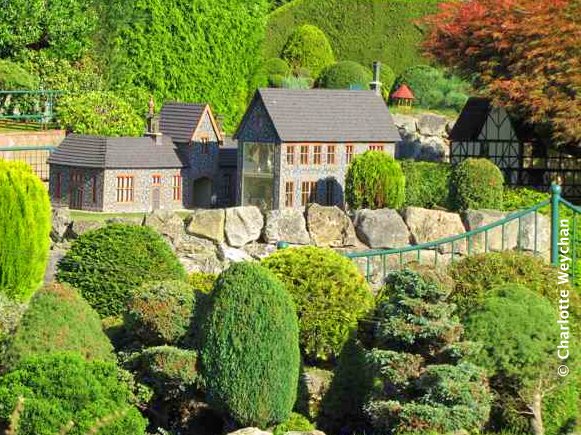
Imagine living in a magical village where you don't need money! Everything is free; you're surrounded by greenery; there's an amusement pier, a fairground and a harbour; and even a free train service to take you to the shops or to see your friends. Everywhere you look there's open spaces and glorious trees ... and the maples are just beginning to turn, so you've got wonderful autumn colours. 
This little Utopia is Bekonscot Model Village in the heart of Beaconsfield, Buckinghamshire - former home of London accountant, Roland Callingham, who had a passion for model railways. He started building this miniature world some 80 years ago, with the help of his gardener, Tom Berry, and today this two-acre site survives in the heart of commuter-belt Britain, and gives pleasure to hundreds of thousands of visitors every year.
This is a classic story of a cloud with a silver lining because this attraction nearly prompted a divorce for its creator! There was a time when Roland Callingham had all his trains in the house rather than outside and his wife finally gave him an ultimatum and said that he had to choose between her and his hobby, because she could no longer live with all the locomotives in the home! So following construction of a swimming pool in the garden in 1927, Bekonscot's creator moved his trains outside and started work on the buildings that make up the village today, including the pier (above) which lies at the heart of the former swimming pool.
Trains here run on the largest Gauge 1 railway in the UK and were built by well-known model railway manufacturer Bassett-Lourke and while they provide the focus for railway enthusiasts, gardeners will be amazed by the immaculate landscapes here at Bekonscot, tended by full-time teams of specialist gardeners (below), well versed in the art of bonsai. It's quite a sight to behold when you see the density of planting!
Bekonscot is open until the end of October, but closes during the winter months - for full information check website through the link above. But even as a gardener, it's certainly worth a visit to marvel at the planting! Combine this with a visit to nearby Waterperry Gardens and you'll get the best of both small and large-scale gardening, and a day to remember.

Saturday, 9 October 2010

Gardens for all seasons - Sheffield Park

There's little doubt that winter's on the way when English gardens close their gates and the mists start rolling in off the sea and leave us swathed in gray until mid morning. So in the next few weeks I'm going to feature gardens that remain open throughout the year, starting with Sheffield Park in East Sussex. This magnificent garden always comes to light at this time of year because of its stunning autumn colours, but in reality, it's a wondrous garden throughout the year and is only closed from 24-27 December this year.
It's the huges expanses of water and the planting around the lakes here Sheffield Park that makes this landscape so remarkable because you get marvellous reflections, particularly from the maples and scarlet oaks at this time of year. Capability Brown and Humphrey Repton both worked here after the property was acquired by the Holroyd family in 1769, although there are no records documenting what they actually did. 

The planting today is largely due to Arthur Soames, who purchased the estate in 1909 and embarked on a major planting programme and built up a magnificent collection of exotic trees, conifers and shrubs suited to the acidic soils found here. He also extended the top lakes and called in Messrs Pulham, who created the Rock Garden at RHS Wisley, to build the cataract between the top and second lake (pictured right).
In winter too, the scenes are spectacular, particularly if a big freeze comes like in the winter of 2009/10 and the lakes ice over, giving an eerie silence to the garden because the water in the lakes stops flowing (below). But Sheffield Park is still stunning in wintertime because Arthur Soames planted so many evergreen trees so there is always something to see here. Definitely a garden for all seasons.

When spring comes, life begins again at Sheffield Park as the daffodils and bluebells arrive. They are followed by spectacular displays of rhododendrons (below) - once again reflected in the lakes. Virginia Woolf, who lived at nearby Monk's House, described them as "massed upon the banks ... and when the wind passes over the real flowers, the water flowers shake and break into each other." 
The National Trust acquired several hundred acres of the gardens when the estate was broken up in the mid 1950's, although the house remains in private ownership. It has now become one of their flagship garden properties and attracts record numbers of visitors each year, particularly in the autumn. For other suggestions on spectacular autumn gardens to visit, you can use this link.

Thursday, 7 October 2010

"Autumn is a second spring when every leaf is in flower"

Albert Camus was right when he said this about autumn - it's the subtle colours and hues when you get them reflected in water (above) and the wonderful light at the end of the day when the sun is shining. The leaves are beginning to turn here in the south of England, but this year I shall miss the really wonderful fiery autumn displays I so enjoy, because I'm leaving for India and after that I'll be back in the US.
So today, I'm going to share some wonderful autumn gardens with readers, that you can visit while I'm away. Scotland has more than it's fair share of gardens that excel in October in terms of colour, like Greenbank (above), Crarae, and the fabulous Benmore Botanic Garden. I'd really hoped to get up there this year to see the autumn colours, but ran out of time.
In the south we are really spoiled, because we have the Savill Gardens (above), many arboretums, and of course, Sheffield Park (below), which is famous the world over for its autumn acer displays. I was there earlier this week, and the colours haven't yet reached their peak, but this is one to put on your list later in October, as is Westonbirt in Gloucestershire. I have to confess I've not yet been to Westonbirt, but it's on my list, but I know that many other British bloggers will feature this wonderful arboretum this autumn.
And there's still time to catch the subtle colours at Great Dixter (below) before it closes at the end of the month. This is a wonderful time to visit this iconic garden, because it's rarely crowded in the autumn.
Heading west, there's the Sir Harold Hillier Gardens (below) near Winchester, which are fabulous in the autumn, and of course, Stourhead. These are two of the great gardens that remain open throughout the year, so once the autumn hues are gone, you've got the joy of misty mornings in the winter months.
And finally the autumn hues of Devon and Cornwall. I visited Marwood Hill (below), just a couple of weeks ago and was bowled over by the glorious colours. And there's plenty more gardens in the area that also have stunning autumn colours, including The Garden House. And as you head further west , further towards the toe of England, there's Lanhydrock, Trebah and many other Cornish gardens that remain open throughout the winter, because the climate there is kinder.